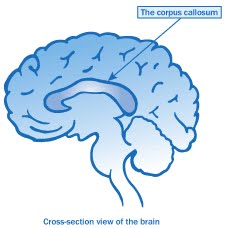
What is the Corpus Callosum? The corpus callosum (call o sum) is the largest connective pathway in a human brain. It is made of more than 200 million nerve fibers that connect the left and right sides (hemispheres) of the brain.
If we cut a brain in half down the middle, we would also cut through the fibers of the corpus callosum. When looking at the middle side of one half of the brain, for example, in magnetic resonance imaging (MRI), the corpus callosum looks like a cross-section of a mushroom cap at the center of the brain.
Each hemisphere of the brain is specialized to control movement and feeling in the opposite half of the body, and each hemisphere specializes in processing certain types of information (such as language or spatial patterns). Thus, to coordinate movement or to think about complex information, the hemispheres must communicate with each other. The corpus callosum is the main connector that allows that communication.
In a typical infant brain, the corpus callosum develops between 12 to 16 weeks after conception (near the end of the first trimester). While the entire structure develops prior to birth, the fibers of the corpus callosum continue to become more and more effective and efficient on into adolescence. By the time a child is approximately 12 years of age, the corpus callosum functions essentially as it will in adulthood, allowing rapid interaction between the two sides of the brain.
From this age on (and typically earlier) as the corpus callosum becomes increasingly functional in their typically developing peers, children with ACC appear to fall behind developmentally because the corpus callosum is absent.
Parents often ask if the corpus callosum is the only path between the hemispheres of the brain. It isn’t the only path, but it is by far the most important. Some much smaller connections are usually present in DCC. The anterior commissure is the largest and most useful of these other pathways. However, it only has about 50,000 nerve fibers, a far cry from the more than 200 million fibers in the corpus callosum.
This information comes straight from NODCC.ORG